
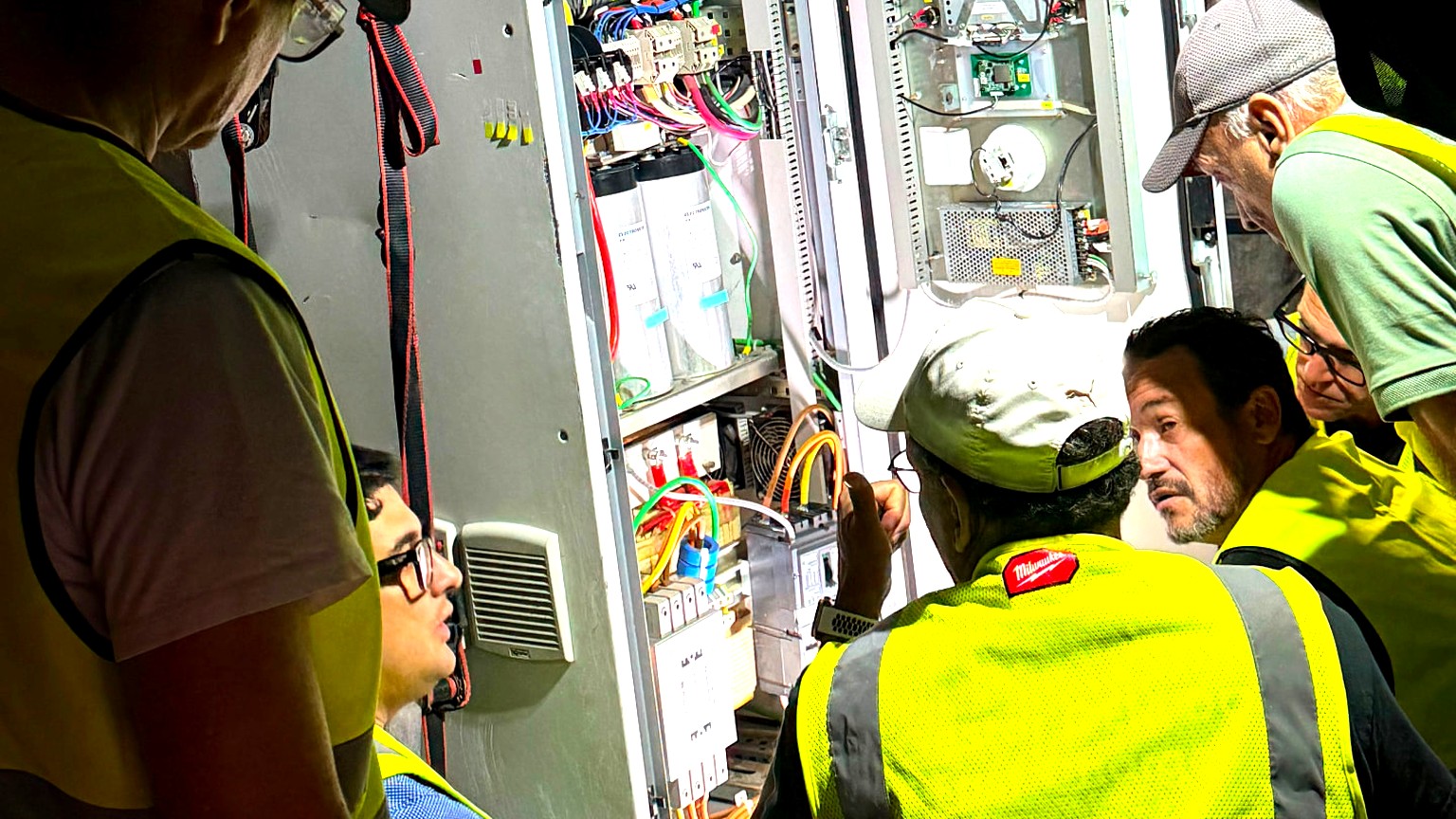
Critical Asset Emergency Simulation
NFPA 70E-Based Electrical Safety, Emergency Response & Asset Recovery
Top Safety Compliance
Rodrigo Macedo · Workplace Safety Specialist
$239
$599
Save $360 · Credit or debit cards.
9:00 PM – 3:00 AM
Next immersion: November 2026
6 hours of continuous night operation
Check program availability
Share this simulation
Send this direct link to your WhatsApp or Telegram groups. It opens with a banner, the simulation details and the registration button.
Safety techniques applied
Technical immersion in workplace safety
- NFPA 70E approach boundaries and risk assessment applied in the field
- Lockout / Tagout (LOTO) and verified de-energization
- Arc flash hazard recognition and PPE selection
- Rescue of an injured technician inside a live technical area
- Radio communication between field crew and control room
- Asset stabilization and initial recovery planning
Realistic Emergency Simulation
Critical infrastructure emergencies rarely happen under ideal conditions.
Equipment alarms, electrical hazards, communication failures, injured personnel, incomplete information and operational pressure can occur simultaneously. The Critical Asset Emergency Simulation places participants inside a controlled scenario designed to recreate the decision-making environment of a nighttime incident involving critical electrical and industrial assets.
This is not a lecture. Participants receive operational roles, use radio communication, respond to evolving conditions, interpret control-room information, apply safety procedures and coordinate their response as the scenario develops.
The Experience
Inside the Simulation
Participants may be assigned operational roles and exposed to a progressive emergency scenario involving:
The exact scenario may vary between editions.
Safety Framework
Safety-First Simulation Environment
All activities must be conducted within a controlled training environment. Training scenarios are designed to demonstrate safety awareness, communication, emergency decision-making and technical coordination while maintaining separation between simulation activities and actual hazardous electrical work.
The program incorporates concepts and work practices informed by NFPA 70E and other applicable workplace-safety principles.
Safety Consulting Partner
Top Safety Compliance
Rodrigo Macedo · Workplace Safety Specialist
Safety consulting support for the simulation program is provided through Top Safety Compliance, with Rodrigo Macedo supporting workplace-safety considerations related to the training environment and simulation structure.
Meet Top Safety Compliance
Simulation Flow
How the Experience Works
Safety Briefing
Participants receive the simulation rules, communication structure, assigned roles and safety boundaries.
Normal Operations
The scenario begins under simulated normal operating conditions.
Incident Escalation
Technical alarms, abnormal conditions and operational information are progressively introduced.
Emergency Response
Participants must communicate, assess information, recognize hazards, coordinate actions and respond to the simulated incident.
After-Action Review
The instructors reconstruct the scenario with the participants, reviewing communication, decisions, safety considerations, technical observations and opportunities for improvement.
After-Action Review
The Learning Happens After the Alarm Stops
Every simulation concludes with a structured After-Action Review. This transforms the exercise from an experience into structured technical learning.
Who It Is For
Designed for Technical Professionals and Teams
Participation does not qualify or authorize an individual to perform regulated electrical, rescue or emergency-response work.
Corporate Version
Private Simulation for Technical Teams
The Critical Asset Emergency Simulation can also be delivered as a private workforce-development experience for technical teams. Scenarios may be adapted around the type of infrastructure operated by the organization, subject to technical feasibility and appropriate safety controls.
Request a Private SimulationCertificate
Certificate of Participation
Participants completing the simulation may receive a Qualifica Certificate of Participation documenting their involvement in the training experience.
The certificate is issued by Qualifica as documentation of participation in the training experience. It is not an NFPA certification, professional license, electrical license, rescue certification, OSHA credential, governmental credential or manufacturer authorization.
Important Legal and Safety Disclaimer
The Critical Asset Emergency Simulation is an educational training experience conducted in a controlled environment. Simulated incidents are designed for instructional purposes and do not constitute actual emergency-response, rescue, electrical licensing or professional certification training unless specifically stated. Training references to NFPA 70E are for educational purposes and do not imply sponsorship, certification or endorsement by NFPA. Participation does not authorize an individual to perform electrical work, energized work, rescue operations or other regulated activities for which specific employer authorization, training, licensing or certification may be required. Actual workplace emergency procedures must follow the participant’s employer policies, applicable regulations, site-specific procedures and requirements established by the appropriate authorities having jurisdiction.
Train for the Moment When Normal Operations Stop.
Experience the communication, technical reasoning and safety decisions involved in a simulated emergency at a critical asset.